
Fashion is a way to express yourself through your clothing style. It also mirrors society. As times change, fashion automatically changes with them, both in men's and women's fashion. After all, every era has its own fashion trends. If we look at the past 100 years, we see that clothing styles are different every decade. From traditional suits to the flower power style, much has changed over the years. But what exactly were those changes?
The journey of men's fashion
1900 - 1940
From 1900 to 1910, we saw many traditional suits in the streets, worn under a long overcoat and a bowler hat. From World War I onwards, the 3-piece suit took over and became the standard. Trousers had a sharp crease for which a special trouser press was used. The top hat was replaced by a flat cap (which we now know as the Peaky Blinders cap).
After the war, from the 1920s, suits were often made of tweed or wool. Accessories such as striking cufflinks, pocket watches, or a walking stick were also added. Then came the 1930s, when shoulder pads were introduced for men, creating the well-known V-shape. The fit of trousers became wider, and the waistband reached the navel. So, many changes were already seen in the first 40 years, but the suit remained the standard.

1900 - 1940
World War II also impacted fashion due to clothing restrictions. Due to material scarcity, less was produced, and there was less supply. People therefore continued to wear old suits.
After the war, you see the influence of uniforms carrying over into everyday street style. For example, you see many trench coats and bomber jackets, with aviator glasses as an accessory. In the 1950s, the range of clothing became much larger again, and lighter fabrics came onto the market. Following women's fashion, more colour variations also emerged for men. Casual and business wear were increasingly combined. The leather jacket also made its debut.
1960 - 1980
In the hippie era of 1960 - 1980, fashion became very diverse. Many colours, various fabrics (velvet), and many specific clothing styles emerged. This was also due to the world becoming smaller (partly because of the growth in aviation), and multiple cultures coming into contact with each other. This led to clothing styles being adopted.
The fit became more slim. Styles were cut tighter to the body and more details were added (e.g., wider lapels). This trend continued even more in the 70s. Shirts also got wide collars and trousers got extremely wide legs. While women's fashion always precedes men's fashion (think of shoulder pads), it also became normal for men to wear platform soles and heels. The business look was influenced by modern style for the first time.
1980 - 2000
In the 80s, suddenly anything was possible, both casual and formal in the office. Men could define their own style, and the 3-piece suit became a thing of the past. Jackets like blazers were worn separately, and the fit became even more tailored. Denim was also increasingly seen under a basic shirt or turtleneck. The flower power fashion ended in the 90s.
Colours were more basic, many shades of grey with a white shirt when it came to suits. The wide trousers made a brief comeback, and in the higher segment, flashy shirts were worn (think of the famous Versace shirts). The tie seemed to disappear, partly due to Prince Claus' legendary speech in 1998.
2000 - 2020
From the new millennium, something changed for good. Fashion became accessible to everyone, and fast fashion made its entrance. Fashion chains emerged that made fashion affordable, and expensive department stores faced difficulties. The waistcoat made a comeback, and gradually the suit became the standard in the office again (which was short-lived). This suit, however, came in multiple colours, which you primarily saw in stores like Suitsupply, for example. From 2010, trousers were replaced by smart jeans or chinos. Moreover, the first sneakers were spotted with suits. Streetwear gained increasing influence.
2020 - Present
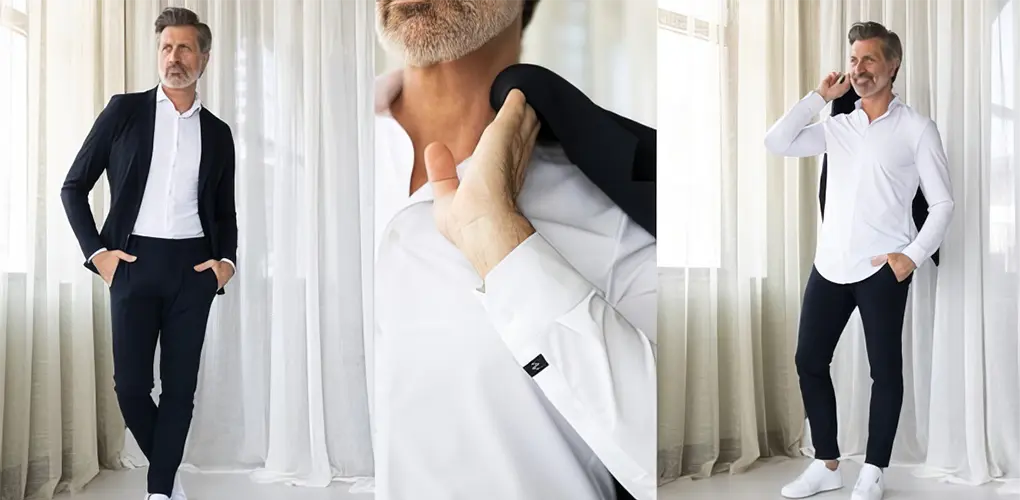
From 2020 onwards, the fashion scene has been largely influenced by Corona. While most of the population was forced to work from home in tracksuits, this unconsciously impacted fashion. The comfort of the tracksuit returned to men's fashion. Lots of stretch (Jersey) fabrics for suits, chinos, and even denim.
Techno jersey fabrics, which have been used longer in women's fashion, are now increasingly seen in men's fashion too. Sneakers are more of a rule than an exception, and casual clothing in the office is becoming more normal. However, we also see that streetwear and business wear are increasingly intertwined. It can be fashionable, but still neat. Find your favourite trousers, blazers, and tops with us.
Men's fashion through the years
It's fascinating to see how fashion represents an era, constantly changing. Sometimes trends return, and you see characteristics from the past in contemporary styles. Currently, the trend seems to be "smart" streetwear, although tight fits are making way for more regular fit models. As a man, you can always look at women's fashion, which is typically about 10 years ahead. Wide fits and techno fabrics, for example, have been part of those collections for longer. Comfort is increasingly important, and Corona has given that an even bigger boost. Whether this will disappear again, only time will tell.
View our collection and feel free to contact us if you have any questions.